
Emergency EU Summit Convened Over Ceuta Migration Crisis
EU holds emergency meeting to address surge in Ceuta migrant crossings. Spain faces tension with member states over migration influx into the enclave.
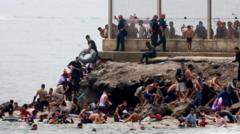
EU Convenes Crisis Session on Ceuta Migration Surge
European Union officials have triggered an emergency diplomatic session to tackle the escalating challenges surrounding Ceuta migrant crossings and the mounting pressures facing Spain's autonomous enclave. The sudden spike in arrivals has created significant friction among member states, prompting Brussels to intervene directly in what has become one of the continent's most contentious migration flashpoints.
Diplomatic Tensions Rise Over Border Management
Sharp disagreements have erupted between Spain and fellow EU nations regarding how to manage the unprecedented wave of individuals attempting to enter the enclave of Ceuta. Officials from multiple member states have engaged in heated discussions about responsibility-sharing and border control protocols, exposing deep divisions within the bloc over migration policy implementation.
The intensity of these Ceuta migrant crossings has strained bilateral relationships and raised fundamental questions about Europe's unified approach to immigration challenges. Spain, as the directly affected nation, has found itself increasingly isolated in advocating for comprehensive EU-wide support mechanisms rather than facing the burden alone.
Strategic Implications and Regional Context
The autonomous enclave's geographic position on Morocco's coast has historically made it a focal point for migration patterns across the Mediterranean region. However, recent months have witnessed an extraordinary acceleration in crossing attempts, transforming routine border management into a full-scale humanitarian and political crisis requiring immediate intervention at the highest governmental levels.
EU leadership recognizes that the migration situation at Ceuta requires coordinated action transcending national interests. The emergency convening demonstrates Brussels' acknowledgment that unilateral Spanish responses prove insufficient for addressing the scale and complexity of current challenges.
EU Member States' Divergent Positions
Within the European Community, member states have articulated conflicting perspectives on burden distribution and accountability frameworks. Some nations emphasize shared responsibility mechanisms, while others prioritize sovereignty in immigration matters, creating obstacles to consensus-building during these critical negotiations.
The diplomatic standoff reveals deeper systemic weaknesses in the EU's common migration framework. Rather than presenting unified solutions, member states have retreated into protectionist postures, complicating international cooperation and undermining collective security arrangements designed to manage cross-border movements effectively.
Humanitarian Dimensions and International Law
Beyond political calculations, the surge in Ceuta migrant crossings raises significant humanitarian considerations regarding vulnerable populations seeking better living conditions. International legal obligations regarding asylum seekers and migrants require EU states to balance security concerns with human rights protections, adding additional complexity to already fraught discussions.
Spain faces mounting pressure to implement stringent border controls while simultaneously adhering to international conventions protecting migrants' fundamental rights. This tension characterizes much of the current debate, as EU partners scrutinize Spain's enforcement mechanisms and policies.
Looking Forward: Potential Solutions
The emergency meeting represents an opportunity for EU institutions to develop coordinated strategies addressing root causes of migration surges rather than merely managing immediate consequences. Discussions are expected to encompass burden-sharing formulas, enhanced border technologies, diplomatic initiatives with Morocco, and reinforced development aid targeting source countries.
Comprehensive solutions to the Ceuta migrant crossings challenge will likely require multifaceted approaches combining enforcement improvements, international cooperation frameworks, and legitimate pathways for migration. EU officials must navigate these competing priorities while maintaining institutional credibility and demonstrating effective governance capabilities.