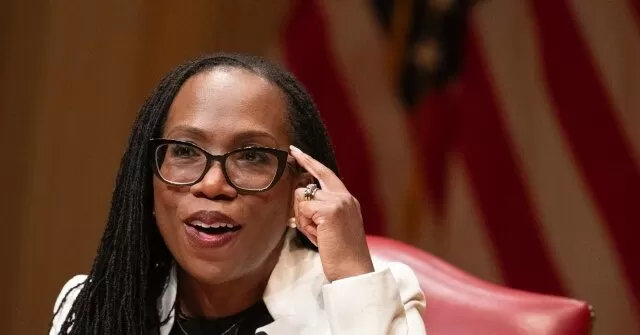
During a recent Supreme Court hearing, Justice Ketanji Brown Jackson made a powerful statement that has sparked a lot of discussion. Her words have been deemed controversial by some, but to others, they have served as a reminder of the ongoing struggles faced by black Americans in our society.
During the hearing on Wednesday, Justice Jackson seemed to compare black Americans to Americans with disabilities. This comparison may seem unusual at first, but upon closer examination, it sheds light on the systemic barriers and discrimination faced by both groups.
Justice Jackson’s statement came during a discussion about the Americans with Disabilities Act (ADA), a landmark civil rights law that prohibits discrimination against individuals with disabilities. The case at hand was brought forth by a deaf man who claimed that a police officer violated his rights under the ADA by failing to provide an interpreter during a traffic stop.
In response to the argument made by the government’s lawyer that the ADA only applies to physical disabilities, Justice Jackson made a thought-provoking analogy. She said, “It’s like saying that the Civil Rights Act only applies to people who are black. That’s not the way civil rights laws work in this country.”
By equating black Americans to Americans with disabilities, Justice Jackson highlighted the fact that both groups have been historically marginalized and discriminated against. Black Americans have faced centuries of systemic racism and oppression, while individuals with disabilities have been denied equal opportunities and access to basic rights.
This comparison is not meant to diminish the unique struggles faced by each group, but rather to draw attention to the common thread of discrimination and the need for equal protection under the law. Justice Jackson’s words serve as a reminder that our society still has a long way to go in terms of achieving true equality.
It is worth noting that this is not the first time that the Supreme Court has addressed the issue of race and disability. In 2017, the Court ruled in favor of a 13-year-old student with autism who was denied access to a service dog at school. The Court recognized that individuals with disabilities, like individuals of different races, should not be excluded or treated differently because of their differences.
Justice Jackson’s statement has been met with both praise and criticism. Some have applauded her for bringing attention to the intersectionality of race and disability, while others have accused her of diminishing the struggles of black Americans. However, her words should not be taken out of context or used to fuel division. Instead, they should be seen as a call to action to address the systemic barriers faced by marginalized communities.
As we continue to fight for equality and justice for all, it is important to recognize that the struggles faced by different groups are interconnected. The fight for civil rights should not be limited to one particular group, but rather it should encompass all marginalized communities.
In conclusion, Justice Ketanji Brown Jackson’s statement during the Supreme Court hearing serves as a powerful reminder of the ongoing struggles faced by black Americans and individuals with disabilities. By comparing the two groups, she has shed light on the need for equal protection and opportunities for all. Let us use her words as motivation to continue the fight for a more just and inclusive society.