
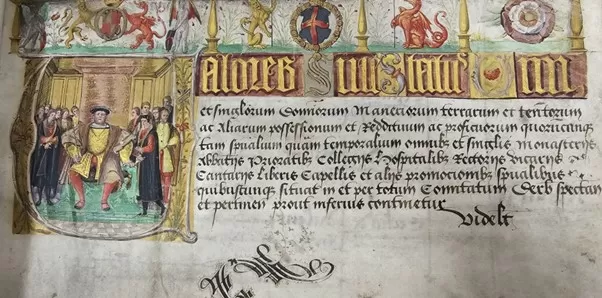
The National Archives has recently taken an important step towards preserving and sharing a significant piece of history. After the break with Rome in 1534, King Henry VIII ordered a financial survey of the Church in England and Wales in order to gain control over its wealth and resources. This survey, carried out by inspectors who travelled the length and breadth of the country, counted a staggering number of religious buildings and institutions. Thanks to the efforts of the National Archives, this financial survey is now accessible to everyone, shedding light on a crucial event in British history.
The survey, which took place in 1535, was a result of King Henry VIII’s desire to break away from the Catholic Church and establish the Church of England. This marked the beginning of the English Reformation and was a turning point in the country’s religious and political landscape. The King’s decision to dissolve monasteries and confiscate their wealth and property was a major source of income for the Crown and had a significant impact on the Church and its followers.
The financial survey was ordered to assess the extent of the Church’s wealth and to identify potential targets for confiscation. The inspectors, who were appointed by the Royal Court, travelled across England and Wales, visiting every parish, monastery, cathedral, chapel, chantry, college, school, hospital, and poor house. They meticulously recorded the details of each institution, making note of their possessions, income, and expenses.
The result of this survey was a detailed and comprehensive account of the state of the Church in England and Wales at the time. It provided valuable information on the wealth and resources of the religious institutions as well as their role in society. The survey also revealed inequalities in the distribution of wealth and highlighted the opulence of some religious establishments, which was one of the reasons behind King Henry VIII’s decision to dissolve them.
The National Archives’ initiative to make this financial survey accessible to the public is a commendable effort. By digitizing and transcribing the documents, they have made it possible for everyone to explore this important piece of history. The survey offers a unique insight into the religious, social, and economic landscape of 16th century England and Wales. It also sheds light on the power dynamics between the Church and the Crown, which ultimately led to the Reformation.
Moreover, the financial survey is a valuable resource for researchers, historians, and anyone interested in the history of the Church and the English Reformation. It provides a wealth of information on individual religious institutions, their income and expenses, and their role in society. This data can be used to analyze the impact of the Reformation on the Church and its followers, and to understand the wider implications of this significant event in British history.
In addition to the digitized documents, the National Archives has also created a user-friendly website, making it easier for people to access and navigate through the survey. The website provides a detailed history of the survey, along with instructions on how to use the documents for research purposes. It also offers a glimpse into the daily lives of the inspectors who travelled across the country, providing a fascinating behind-the-scenes look at the making of this survey.
The National Archives’ efforts to make this financial survey accessible to all is a testament to their commitment towards preserving and sharing our country’s rich history. This valuable resource will not only help us understand the past, but also inform our present and shape our future. By making these documents available to the public, the National Archives has made a significant contribution towards promoting transparency and accountability in the management of the Church’s wealth and resources.
In conclusion, the National Archives’ project to digitize and make accessible the financial survey of the Church ordered by Henry VIII is a commendable effort. This survey, which counted over 8,000 parish churches, 650 monasteries, 22 cathedrals, and numerous other religious institutions, offers a unique insight into the religious, social, and economic landscape of 16th century England and Wales. It is a valuable resource for researchers and history enthusiasts, and a crucial piece of our nation’s history. Thank you, National Archives, for making this important survey accessible to all.