
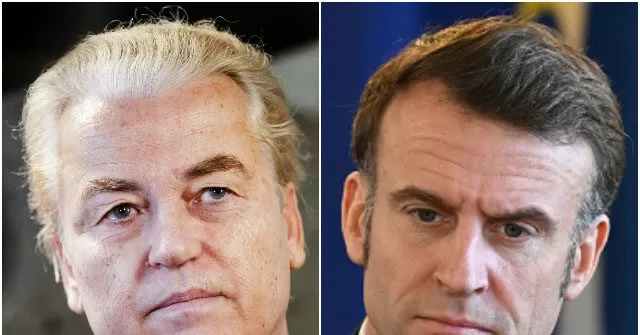
Dutch right-wing leader Geert Wilders has once again made headlines with his controversial remarks, this time directed towards French President Emmanuel Macron. In a recent social media post, Wilders sarcastically suggested that southern France could become the new Palestinian state, while also declaring “Good luck Emmanuel Macron and France! Happy suicide!” This provocative statement has gained massive international attention and sparked a heated debate on the issue of recognizing a Palestinian state.
The context of Wilders’ statement lies in Macron’s recent decision to recognize a Palestinian state. This move has been met with both support and criticism, with some applauding Macron for taking a stand for Palestinian rights, while others, like Wilders, have condemned the decision as a form of “suicide” for France.
In his post, Wilders directly addresses Macron, stating “Good luck Emmanuel Macron and France!” This sarcastic remark highlights Wilders’ belief that France’s decision to recognize a Palestinian state will have negative consequences for the country. He goes on to suggest that southern France could become the new Palestinian state, implying that this decision will lead to an influx of Palestinian refugees into the region.
Wilders’ statement has been met with strong reactions from both sides. Some have condemned his remarks as inflammatory and divisive, while others have praised him for speaking out against what they see as a dangerous decision by Macron. Regardless of one’s stance on the issue, it is clear that Wilders’ words have sparked a much-needed conversation on the complexities of the Israeli-Palestinian conflict.
The fact that Wilders’ statement has gained massive international attention is a testament to the power of social media in shaping public discourse. In today’s digital age, politicians and leaders have a direct platform to share their opinions and reach a global audience. However, with this power comes great responsibility, and Wilders’ controversial post serves as a reminder of the impact that words can have on a larger scale.
While some may view Wilders’ statement as offensive and divisive, it is important to understand the underlying message behind his words. Wilders’ concern for the well-being of France and its people is evident in his statement. He believes that recognizing a Palestinian state will have negative consequences for the country, and he is using his platform to voice his concerns.
Furthermore, Wilders’ statement sheds light on the issue of Palestinian statehood and the complexities surrounding it. The Israeli-Palestinian conflict has been ongoing for decades, and finding a solution that satisfies both sides has proven to be a daunting task. Macron’s decision to recognize a Palestinian state is just one step in a long and complicated process, and Wilders’ statement serves as a reminder that there are no easy solutions to this conflict.
In conclusion, Geert Wilders’ recent statement directed towards Emmanuel Macron has sparked a heated debate on the issue of recognizing a Palestinian state. While his words may be controversial, they have shed light on the complexities of the Israeli-Palestinian conflict and the impact that political decisions can have on a global scale. It is important for leaders to use their platforms responsibly and engage in constructive dialogue to find a peaceful resolution to this ongoing conflict.