
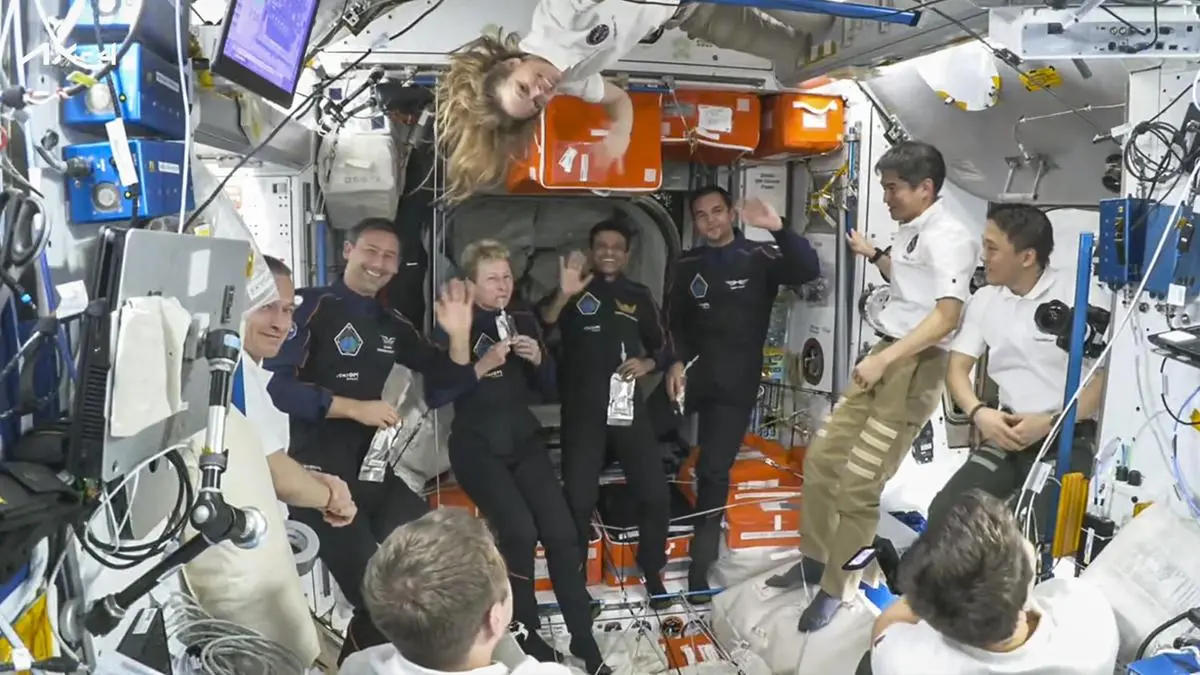
On Thursday, history was made as the Dragon spacecraft successfully docked with the orbital laboratory, carrying four astronauts on board. After a 28-hour journey around the earth, the spacecraft safely reached its destination, marking a significant milestone in space exploration.
The Dragon spacecraft, developed by SpaceX, is a state-of-the-art vehicle designed to transport astronauts to and from the International Space Station (ISS). This mission, known as Crew-1, is the first operational flight of the spacecraft, following a successful test flight earlier this year.
The four astronauts on board, NASA’s Michael Hopkins, Victor Glover, and Shannon Walker, along with Japan Aerospace Exploration Agency’s Soichi Noguchi, have been eagerly waiting for this moment. They will now join the current ISS crew, making it a total of seven people on board the station.
The journey of the Dragon spacecraft began on Sunday, when it was launched from the Kennedy Space Center in Florida. The spacecraft, attached to a Falcon 9 rocket, blasted off into the sky, leaving behind a trail of smoke and fire. It was a sight to behold, and the whole world watched in awe as the spacecraft embarked on its journey.
After a successful launch, the Dragon spacecraft entered orbit and began its journey towards the ISS. The 28-hour journey was not an easy one, as the spacecraft had to travel at a speed of over 17,000 miles per hour to catch up with the orbital laboratory. However, the spacecraft’s advanced technology and the expertise of the astronauts made the journey smooth and efficient.
As the spacecraft approached the ISS, it performed a series of maneuvers to align itself with the docking port. This process, known as “soft capture,” is a critical step in the docking process, and it requires precision and accuracy. The Dragon spacecraft passed this test with flying colors, and it was a moment of relief and joy for everyone involved.
Finally, after a few hours of checks and preparations, the Dragon spacecraft successfully docked with the ISS, making a firm connection with the orbital laboratory. The astronauts on board the ISS welcomed their new crew members with open arms, and it was a heartwarming moment to witness.
This successful docking is a testament to the hard work and dedication of everyone involved in this mission. From the engineers and scientists who designed and built the spacecraft to the astronauts who trained tirelessly for this moment, everyone played a crucial role in making this mission a success.
The Dragon spacecraft is not just a vehicle; it represents the future of space exploration. With its advanced technology and capabilities, it will pave the way for more ambitious missions, including sending humans to Mars. This successful docking is a significant step towards achieving this goal, and it has opened up a world of possibilities for the future.
The Crew-1 mission is also a symbol of international cooperation and collaboration. The four astronauts on board come from different countries, but they have come together to work towards a common goal. This mission has shown that when we work together, we can achieve great things, and the possibilities are endless.
As we celebrate this historic moment, we must also remember the sacrifices and risks that these astronauts have taken to make this mission a success. They have left their families and loved ones behind to embark on this journey, and their bravery and determination are truly commendable.
In conclusion, the successful docking of the Dragon spacecraft with the ISS is a momentous achievement that will go down in history. It is a testament to human ingenuity, determination, and the spirit of exploration. This mission has shown that we are capable of achieving the impossible, and it has inspired a whole new generation to reach for the stars. The future of space exploration is bright, and we can’t wait to see what lies ahead.