
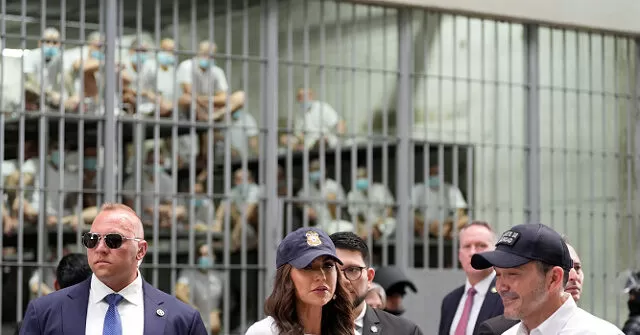
The Department of Homeland Security (DHS) Secretary Kristi Noem recently visited El Salvador to tour a prison holding hundreds of deported alleged gang members associated with Tren de Aragua (TdA) and MS-13. This visit, which took place on Tuesday, marked a crucial moment in the fight against these notorious gangs and their transnational criminal activities.
Ms. Noem’s visit to the Central American country was part of her broader mission to strengthen cooperation and partnerships with other countries to combat gang violence and illegal immigration. El Salvador, which has been plagued by gang violence for decades, has been a key partner in these efforts. The country has worked closely with the United States in sharing intelligence and information to identify and deport gang members.
During her tour of the prison, Ms. Noem was accompanied by high-ranking officials from both the U.S. and El Salvador. She was given a thorough briefing on the conditions and security measures in place at the facility, which primarily houses TdA and MS-13 members who have been deported from the U.S.
The Secretary was impressed by the level of cooperation and coordination between U.S. and Salvadoran authorities in managing the prison and dealing with the deported gang members. She praised the joint efforts and stated, “These partnerships are crucial in fighting dangerous transnational gangs and ensuring the safety and security of both our countries.”
The TdA and MS-13 are known for their ruthless criminal activities, which include drug trafficking, extortion, and murder. Their reach extends beyond El Salvador, with operations in Mexico, Guatemala, and the U.S. It is estimated that there are over 10,000 active gang members in El Salvador alone, with many others operating in neighboring countries.
The U.S. has been a prime target for these gangs, with an estimated 5,000 TdA and MS-13 members being deported annually. These deportations not only help reduce gang violence in the U.S., but they also weaken the gangs’ operations in their home country. The U.S. government has been working closely with El Salvador to identify and deport these individuals, and the partnership has yielded significant results.
Ms. Noem’s visit serves as a reminder of the efforts being made by both countries to combat gang violence and illegal immigration. It highlights the importance of international partnerships in addressing transnational criminal activities that threaten the safety and security of both countries.
The cooperation between the U.S. and El Salvador goes beyond just deportations. Through joint efforts, both countries have worked to disrupt and dismantle the financial networks of these gangs, making it harder for them to operate. Additionally, programs have been put in place to provide education and job opportunities for at-risk youth in El Salvador, diverting them from a life of gang violence and crime.
Ms. Noem’s visit also brings attention to the need for ongoing support and resources to effectively combat these gangs. The U.S. government has committed to providing continued assistance to El Salvador to strengthen their law enforcement and improve the living conditions of its citizens.
As Secretary Noem’s visit came to an end, she expressed her gratitude to the Salvadoran government for their cooperation and partnership. She also reiterated the U.S.’s commitment to working hand in hand with El Salvador to address the challenge of transnational gangs.
This visit serves as a testament to the hard work and dedication of both countries in tackling gang violence and illegal immigration. Through joint efforts and strong partnerships, the fight against TdA and MS-13 will continue, and their operations will be disrupted. Secretary Noem’s visit reinforces the message that the safety and security of both the U.S. and El Salvador are of utmost importance and must be protected at all costs.