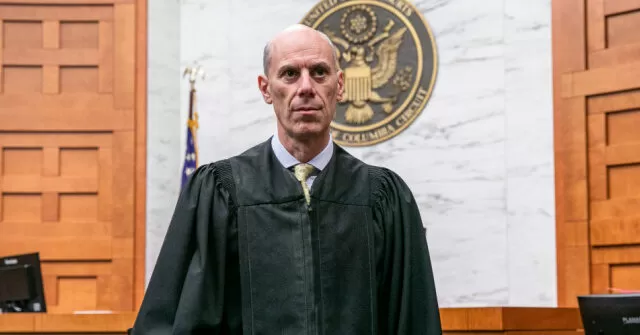
The recent ruling by an Obama-appointed federal judge against President Donald Trump’s deportations of suspected Tren de Aragua (TdA) gang members has sparked controversy and raised questions about the judge’s impartiality. It has been revealed that this same judge played a key role in the failed Russia-Trump collusion accusations while presiding over the Foreign Intelligence Surveillance Act (FISA) Court. This revelation has shed light on the judge’s past actions and has raised concerns about the fairness of the ruling.
According to reports, Judge James E. Boasberg, who was appointed by former President Barack Obama in 2011, was the presiding judge of the FISA Court during the time when the infamous Steele dossier was used to obtain surveillance warrants on Trump campaign adviser Carter Page. The dossier, which was funded by the Democratic National Committee and the Hillary Clinton campaign, contained unverified and salacious allegations about Trump’s ties to Russia. This dossier was a crucial piece of evidence in the Russia-Trump collusion investigation, which ultimately turned out to be baseless.
It is concerning that Judge Boasberg, who was responsible for overseeing the FISA Court and ensuring the accuracy and validity of the warrants, failed to properly scrutinize the evidence presented to him. The fact that he allowed the use of the unverified Steele dossier as a basis for obtaining surveillance warrants raises serious questions about his judgment and impartiality. This is especially troubling considering that the FISA Court operates in secrecy and relies heavily on the integrity of the presiding judge.
Furthermore, Judge Boasberg’s involvement in the Russia-Trump collusion hoax has now extended to his ruling against the Trump administration’s efforts to deport suspected TdA gang members. The TdA gang, also known as the Aragua Train, is a notorious criminal organization from Venezuela that has been involved in drug trafficking, extortion, and murder. The Trump administration had designated the TdA gang as a transnational criminal organization and had initiated deportation proceedings against its members who were living in the United States illegally.
However, Judge Boasberg blocked these deportations, citing concerns about the safety of the gang members if they were to be deported back to Venezuela. This ruling has been met with criticism, as it seems to prioritize the safety of criminals over the safety of American citizens. It is also worth noting that Venezuela is currently facing a humanitarian crisis and is considered one of the most dangerous countries in the world. It is highly unlikely that the TdA gang members would face any danger if they were to be deported back to their home country.
The fact that Judge Boasberg has once again made a controversial ruling that goes against the Trump administration’s policies raises questions about his motives and biases. It is clear that he has a history of siding with the Democrats and their agenda, as seen in his involvement in the Russia-Trump collusion hoax. This raises concerns about the fairness and impartiality of his decisions.
In light of these revelations, it is imperative that Judge Boasberg’s actions are thoroughly investigated. The American people deserve to know the truth about the judge who is responsible for overseeing the FISA Court and making important rulings that affect the safety and security of the country. It is also crucial that steps are taken to ensure that the FISA Court operates with transparency and accountability in the future.
In conclusion, the recent ruling by Judge Boasberg against the Trump administration’s deportations of suspected TdA gang members has brought to light his involvement in the failed Russia-Trump collusion accusations. This raises serious concerns about his impartiality and judgment, especially considering his role as the presiding judge of the FISA Court. It is time for a thorough investigation into Judge Boasberg’s actions and for measures to be taken to prevent any further bias in the FISA Court. The American people deserve a fair and just legal system, and it is the responsibility of those in positions of power to ensure that this is upheld.