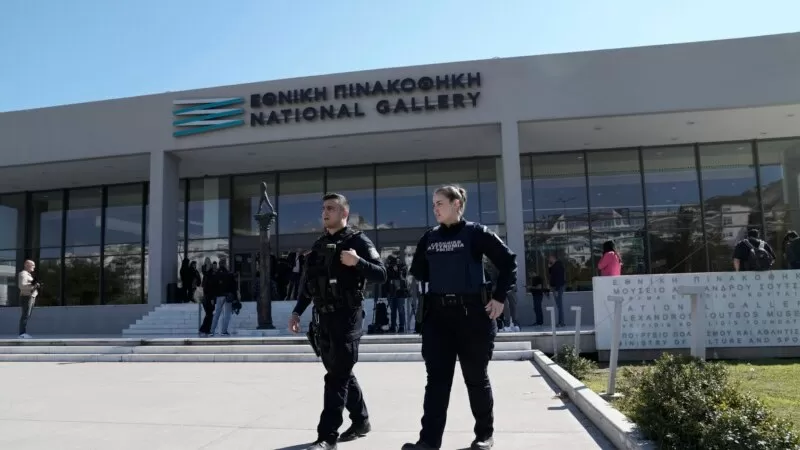
ATHENS – An act of vandalism at the National Gallery in Greece has sparked outrage and condemnation from the art community and human rights organizations. On Monday, a far-right Greek lawmaker, Nikolaos Papadopoulos, attacked four paintings in an exhibition at the gallery, claiming they were offensive due to their distorted depictions of Christ and the Virgin Mary.
The incident occurred during the exhibition “The allure of the bizarre,” which features works by a group of Greek artists inspired by the Spanish master Francisco de Goya. The exhibition has been on display at the National Gallery since January and has been a popular attraction for both Greeks and tourists.
According to the gallery’s statement, Papadopoulos, a member of the ultra-religious Niki party, violently took down four paintings from the exhibition with the help of another person. The paintings were then thrown to the ground, resulting in damage to the artwork. The gallery was forced to close for the day due to the incident.
Papadopoulos’ lawyer, Constantinos Vathiotis, claimed that his client was illegally detained for five hours. However, under the Greek constitution, lawmakers are protected from arrest and their immunity can only be lifted by parliament.
The exhibition, which showcases works corresponding with 80 etchings from Goya’s Los Caprichos series, has been met with controversy since its opening. In January, Papadopoulos submitted a question to the culture ministry, expressing his concerns about one painting in particular. He claimed that the painting was “clearly offending the Orthodox Christian faith” and “directly insulting the holy faces of Virgin Mary and Christ, which are depicted distorted.”
The culture ministry responded at the time, stating that they “never engage in censorship” and that freedom of art and expression are protected by the constitution.
The Hellenic League for Human Rights has condemned Papadopoulos’ actions, stating that “freedom of art and expression are protected by the constitution and should not be subject to personal taste or religious and ideological beliefs of self-appointed judges.”
This act of vandalism has sparked a larger conversation about the role of art and freedom of expression in Greece. Many artists and activists have expressed their support for the exhibition and condemned any attempts to censor or damage artwork.
The National Gallery has also released a statement, expressing their disappointment and stating that they will not tolerate any form of violence or vandalism towards their exhibitions.
The incident has also shed light on the rise of far-right extremism in Greece. The Niki party, which Papadopoulos is a member of, has been known for their extreme religious views and has been accused of promoting hate speech and discrimination.
In a country known for its rich history and cultural heritage, it is important to protect and preserve freedom of expression and artistic expression. Art has always been a medium for social and political commentary, and attempts to censor or damage it only hinder progress and limit the diversity of voices and perspectives.
The National Gallery and the artists involved in the exhibition should be commended for their courage and dedication to showcasing thought-provoking and challenging artwork. It is through these exhibitions that we can engage in important conversations and promote understanding and tolerance.
As the investigation into this incident continues, it is important for the Greek government to take a stand against any form of censorship or violence towards art. The protection of freedom of expression and artistic expression should be a top priority in a democratic society.
In the words of Greek philosopher Plato, “The arts are the fairest and most memorable part of the human experience.” Let us continue to celebrate and protect the beauty and power of art, and reject any attempts to silence it.